
Shot Type
Put the Product in the Customer's Life — Without Renting the Life
A lifestyle shot places the product in a real-world context — a kitchen counter, a gym bag, a café table — and answers the question every shopper silently asks: 'what does this look like in my life?' It's the workhorse of ads and social because context creates desire in a way isolation can't. It's also the shot where amateurs one-shot everything ('woman in kitchen holding product, professional, beautiful') and get compromises on every element, because the AI has to solve for person, product, pose, environment and lighting simultaneously.
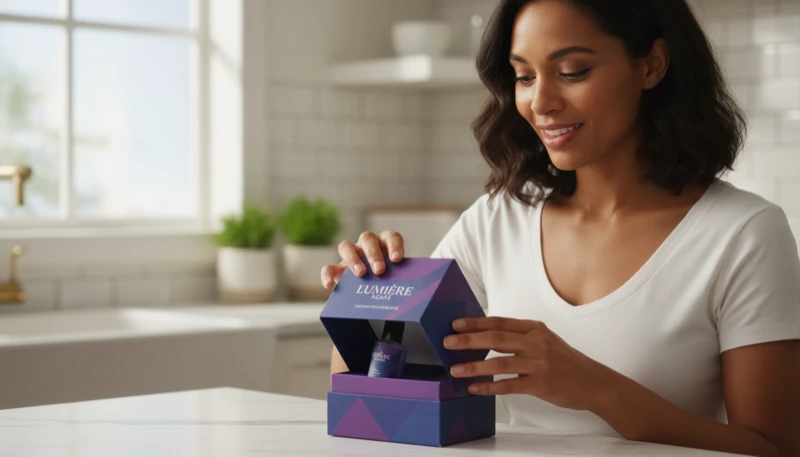
When to Use This Shot Type.
Paid ads on Meta and TikTok, where in-context creative that looks native to the feed consistently outperforms catalog shots — and where you need constant fresh variations to fight creative fatigue
Instagram and Pinterest content, where aspirational, in-context imagery is the format
Secondary PDP images that show scale, context and use after the packshot has done the accuracy work
Email and landing page heroes where the environment carries the brand story
How Dezygn Creates These.
The professional move is to build the scene before you place the product. In Dezygn, scenes are generated as standalone ingredients — empty, no people, no products, 3-4 angles per location with matching light — and saved to your library. Then the product (anchored by its real photo) and the model are composited in. Complex images are built sequentially, not in one shot. Each step produces a validated asset, so errors get caught early instead of compounding.
The Visual Syntax recipe for lifestyle: Style is lifestyle/natural — authentic feel, candid moment. Scene is where the work happens, and it should come from your brand identity, not from a generic preset. If the brand world is 'Mediterranean coastal, olive groves, sun-bleached linen, terracotta and sage,' a neon Tokyo alley is jarring — and so is a generic 'modern kitchen.' Camera: 50mm at f/1.8-f/2.8. 50mm is how human eyes perceive space; it feels honest, approachable, real — which is exactly the emotional register lifestyle needs.
Lighting is 50% of the equation. Natural window light or golden hour, soft and directional, sells 'real moment.' Get the light wrong and no amount of styling saves the image.
Pro Tips.
01
Default to mid-shots, not wide shots
Wide shots are landscape photography; mid-shots are product photography with environment. Go wide and the product becomes a small element in a pretty scene. When a brief calls for dramatic environments, frame mid so the storytelling and the product both survive. This rule came out of real apparel client work, where wide 'epic' shots kept burying the jacket.
02
Build a scene library per client
Generate each location empty, in 3-4 angles with consistent lighting, and name them clearly. Scenes don't involve product or model accuracy, so they can be produced in advance — which means campaign day is composition day, not generation day.
03
Anchor scenes in brand research, not adjectives
The difference between $10/image and $100/image lifestyle work is research. For a Japanese eyewear client we traced the brand's craft origins to Sabae, Japan's eyewear capital, and used the surrounding region as the visual universe. You don't need to show the landmark — the research shapes every scene decision and the images stop looking like everyone else's.
04
Golden hour is for matte products and people
Golden hour is single-direction light. It's beautiful on skin, fabric and ceramics — and it does not work for reflective products. Glass, metal and jewelry need soft multi-directional studio light so their surfaces stay readable. Match the lighting recipe to the material before you fall in love with a mood.
05
Add one trace of life
A hand reaching in, a half-finished coffee, an open book — small human traces make a scene feel lived-in instead of staged. You don't need a full model in every lifestyle frame; you need evidence that a person was just there.
Create Lifestyle Photography with AI.
Generate professional lifestyle photography in minutes, not hours. Dezygn's AI understands composition, lighting, and brand consistency.
Start FreeRelated Shot Types.
Hero Shot Photography
The hero shot is the statement image — the one at the top of the product page, the campaign visual, the image that has to carry the brand's ambition on its own. Where the packshot's job is accuracy, the hero shot's job is desire. It says 'this subject is special' through lighting, isolation and depth, not through claims. Most products get exactly one hero shot per campaign, which means this is the image where craft is most visible — and where slot-machine prompting is most obvious.
Learn moreModel Shot Photography
Model shots put the product on a person — worn, held, used. For entire categories they aren't optional: eyewear, jewelry and apparel barely sell without a face or a body in frame, because fit is the purchase question. The professional standard is the dedicated model: one consistent, brand-matched face that appears across the whole campaign, so your store doesn't look like it hired a different person for every photo. The amateur standard is whatever face the slot machine spits out today.
Learn moreUGC-Style Photography
UGC-style shots imitate what a happy customer would post: iPhone aesthetic, imperfect lighting, candid framing, real-life clutter. In feeds and ad placements they routinely outperform polished studio work because they don't pattern-match to 'advertisement' — they pattern-match to 'person like me.' The paradox is that good UGC is deliberately engineered: the imperfection is specified, not accidental. Random sloppiness reads as low quality; designed authenticity reads as trust.
Learn more