
Use Case
In Supplements, the Label IS the Product
Capsule counts, claims, ingredient panels — supplement customers read everything. Photography that garbles a label doesn't just look bad; it reads as untrustworthy in a category built on trust.
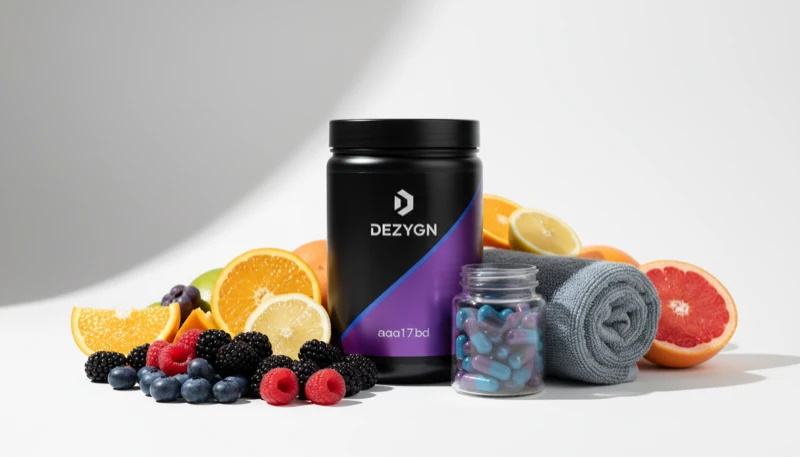
The Challenge.
No category punishes sloppy AI imagery faster than supplements. The product is a bottle whose entire surface is information — brand name, formula, capsule count, claims — and text is exactly where careless generation fails loudest. One garbled word on a label in your ad and the customer's takeaway is 'fake product.'
The format is also repetitive in a way that exposes inconsistency: most supplement brands carry a line of near-identical bottles that differ only in label and accent color. Shot separately over time, the catalog drifts — different lighting, angles, shadows — and the storefront reads as amateur exactly where it needs to read as clinical.
And supplements live or die on lifestyle context: the morning routine, the gym bag, the kitchen counter. White-background compliance shots don't sell wellness; scenes do. Producing both tracks — clinical catalog plus lifestyle volume for ads — doubles the traditional production bill.
How Dezygn Solves This.
Supplement work in Dezygn is built on the production rules that keep text alive. Sources at 2K minimum with label text at least ~100px tall, because the AI cannot add information that isn't in the source. Output resolution matched to input, because rendering a 2K source at 1K output downscales label type into mush — the most common 'AI can't do labels' complaint is actually a settings bug. Real product photos anchor every generation, so the bottle that ships is the bottle in the picture: '120-count amber glass bottle, white safety cap, matte label' — specificity in, accuracy out. For the catalog, the packshot recipe is locked once — 85mm, f/8, high-key, consistent contact shadow — and applied across the entire line in one batch, so twelve SKUs look like one brand. For lifestyle, wellness-coded scenes (botanicals, natural wood, morning window light) and brand-matched models cover the ad volume, with honest framing: ritual and routine, not fabricated body-results claims that get ad accounts banned.
Label-Legible by Engineering
The 2K source rule plus output-resolution matching keeps ingredient panels and brand type crisp — the difference between clinical and counterfeit.
Whole-Line Consistency
Lock the packshot recipe once and batch the entire SKU line — identical lighting, angle and shadow from your bestseller to your newest formula.
Wellness Scenes That Convert
Morning counters, gym bags, botanical settings — lifestyle context generated as reusable scenes, matched to your brand palette.
Routine Moments With Real People
Brand-matched models mid-routine — capsule in hand, shaker on the bench — using action vocabulary that reads authentic instead of staged.
Ad Variations on Demand
Same bottle, fresh contexts weekly. The creative testing volume performance supplements brands need, without a recurring studio bill.
≥100px
Critical label text height in the source image
1 batch
Full SKU line shot with identical setup
2K+
Output resolution for label-sharp deliverables
Ready to Transform Your Supplements Photography?
Shoot Your Whole Supplement Line This Week
Start FreeRelated Use Cases.
Skincare
Frosted glass, dropper caps, cream textures, golden-hour bathrooms — skincare is the most light-sensitive category in e-commerce, and the one where an inaccurate render costs you the customer's trust.
Fitness
A dumbbell on white is a commodity photo. A determined athlete mid-rep with your dumbbell is a brand. The difference is the Action ingredient — and it's directable.
Food & Beverage
Food is the category where AI realism is least forgiving — so professionals shoot it packaging-first: accurate packs, styled scenes, real ingredient context, and restraint where the uncanny valley still bites.